
Blog
How to find names that work across borders
A name that looks elegant on paper can turn into a tongue twister at Sunday dinner. Here is how to find one that survives contact with both sides of the family, and both passport offices.
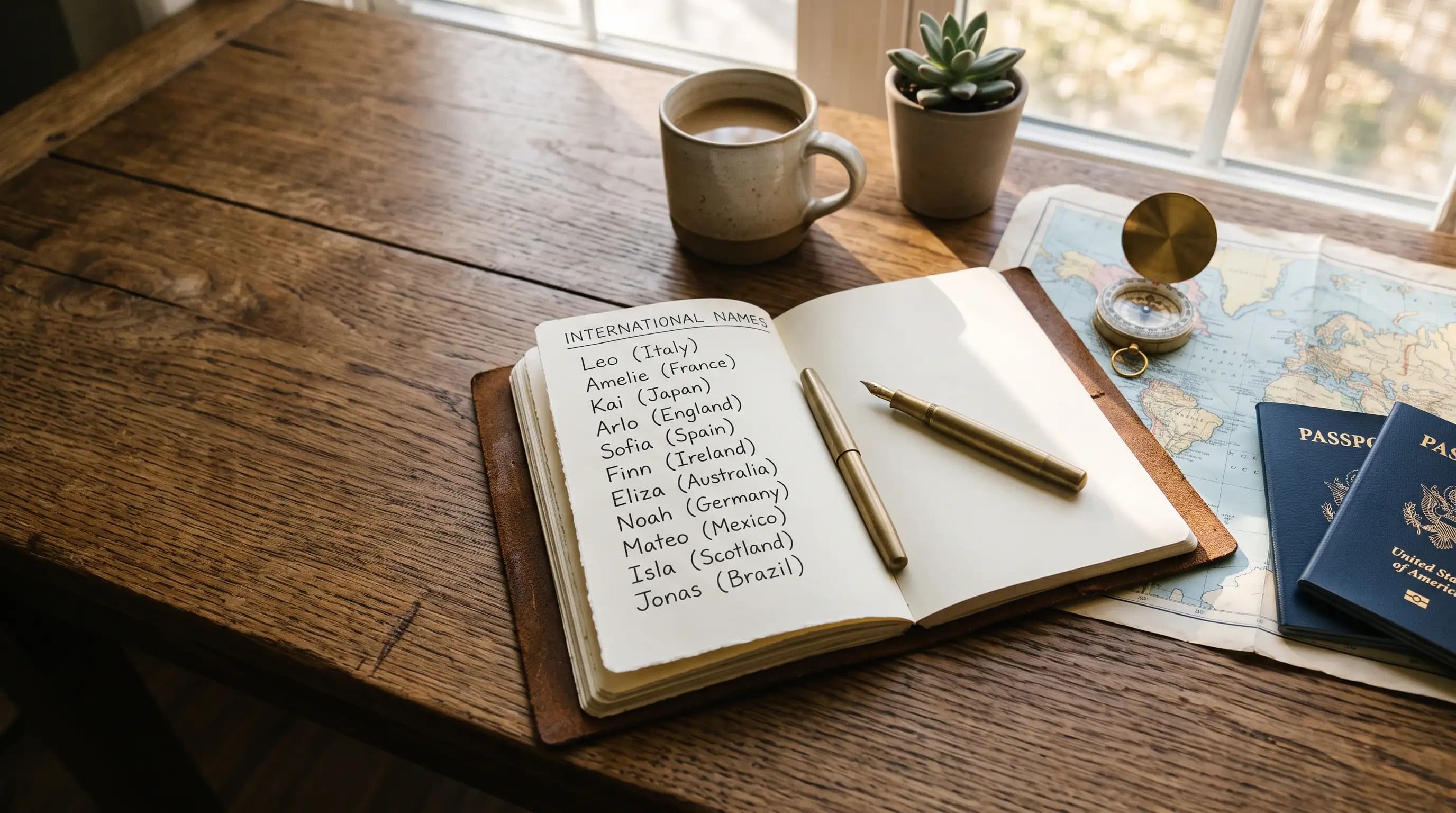
Naming a child across two cultures sounds romantic until both grandmothers start trying to pronounce it. What reads like an elegant, cosmopolitan name on paper often turns into an awkward tongue twister over Sunday dinner. One side of the family swallows half the vowels, while the other side adds an extra syllable just to get through the consonants.
A name does not live in an ivory tower. It lives in crowded classrooms, busy airports, doctors’ waiting rooms, and messy family video calls. When a child carries heritage from two distinct linguistic backgrounds, finding a moniker that works across borders is not about finding a magical word that exists identically in both lexicons. It is about choosing a name that survives contact with both sound systems without losing its dignity.
The phonetic overlap rule
Languages do not share the same vocal mechanics. English leans heavily on dynamic stress and unpredictable vowel shifts. Spanish relies on clean, predictable, open vowels. French pushes sounds through the nasal cavity, while Arabic and Hindi demand throat and tongue positions that English speakers routinely butcher.
If you want a name that travels well, you have to find the phonetic intersection where both languages comfortably meet. That means looking at the specific sounds both languages share rather than translating an existing favorite.
Take the letter combinations. In English, the soft “J” creates a gentle glide, as in Julian. Put that exact same spelling in front of a Spanish speaker, and it becomes an aspirated throat sound, closer to an English “H.” Put it in front of a German speaker, and it turns into a “Y” sound. None of these pronunciations are wrong, but they create three completely different names in practice. If you want consistency, you look for consonants that stay grounded across borders, like M, N, L, T, and D.
Before getting bogged down in endless family debates, start by consulting our comprehensive baby naming guide to set your baseline criteria on rhythm and syllable weight. Once you establish those ground rules, filtering for multiple languages becomes much simpler.
Look for shared roots, not identical spellings
Many parents waste months searching for names that look identical in two different alphabets or traditions. That is a trap. You end up with a shortlist of three hyper-common names that everyone uses because they feel safe.
A better approach is tracking shared etymology. The Mediterranean, the Middle East, and Europe share centuries of overlapping trade, migration, and language evolution. Because of this shared history, thousands of names share roots while maintaining local charm.
Consider the Hebrew root for Hannah. It moves into Spanish and English as Anna, into Russian as Anya, into Arabic as Hana, and into French as Anne. The child is recognized instantly everywhere, yet the name never feels like an awkward foreign import in either grandparent’s living room.
Names that share a root across cultures
| Name concept | Culture A variant | Culture B variant | Shared phonetic core | Why it works across borders |
|---|---|---|---|---|
| Miriam / Mary | Maria (Spanish/Italian) | Maryam (Arabic/Persian) | Mar- / M-R-M | Intuitive vowels, no harsh consonant clusters |
| Alexander | Sasha (Eastern European) | Alex (Western English) | Al- / Lek | Short, universal nicknames fit playground culture |
| Darius / Daria | Dara (Celtic / Persian) | Daria (Slavic / Italian) | Da-ree-ah | Simple open syllables, universal cadence |
| Lucas / Luke | Luka (Balkan / Slavic) | Luca (Italian) | Loo-kah | Two syllables, stress on the first, crisp ending |
When you hit a creative wall trying to balance these sounds, running different root syllables through the baby name generator can help spark ideas that fit specific phonetic constraints. It lets you test diverse origins without boxing your search into conventional lists.
The bureaucracy of naming: visas, passports, and travel
A cross-border name will eventually meet government paperwork. This is where creative parenting crashes headfirst into civil registries, consular database limits, and airline reservation systems.
Every country has its own rules for what can legally appear on a birth certificate. In the United States and the United Kingdom, registries are remarkably flexible with spelling, but they generally reject special characters, numbers, and non-Latin alphabets. In contrast, several European countries maintain strict approved lists or reject names that cause confusion regarding gender or spelling.
Then comes the issue of diacritical marks. Accents, tildes, umlauts, and cedillas carry crucial pronunciation cues in French, Spanish, German, and Scandinavian languages. Yet the moment you book an international flight, standard booking engines strip those marks out entirely. A child named Inès becomes INES. A boy named Søren becomes SOREN or SOEREN.
If your family travels frequently between dual-citizen homes, consistency across travel records matters immensely. Passenger manifest data at major international transit hubs must match your legal documents exactly, and immigration officers expect passport spellings to match international flight records exactly.
For formal entry requirements, dual citizenship declarations, and naming regulations on international forms, always verify rules directly through your destination country’s official consulate or national travel authority rather than a name-advice article.
The playground shout test
A name can look gorgeous on a birth announcement and pass every bureaucratic check, but still fail miserably on the playground.
Children shorten names instinctively. If you pick an elaborate three-syllable cross-cultural name, your child will end up with a nickname whether you like it or not. You need to inspect the natural nicknames in both languages. Reviewing our breakdown on what makes a good nickname can help you spot potential traps before playground peers invent their own version.
Walk out into a hallway or a back garden and say the full name aloud ten times. Then say it as if you need a toddler to stop running toward a street. If the name feels heavy, clunky, or awkward to shout, it is going to cause friction.
A name with two syllables and clear stress on the first syllable is historically the most durable structure in spoken communication. Names like Maya, Leo, Nina, and Felix cross borders cleanly because they require zero acrobatic tongue movements. They are punchy, friendly, and hard to mishear over background noise.
An honest mistake: the silent letter blunder
Years ago, close friends of mine decided to honor both French and English family roots by naming their son Louis. On paper, it was classic, timeless, and sophisticated.
In France, the name is pronounced Loo-ee, with a silent ending. In the United States and parts of the UK, casual acquaintances and school attendance clerks constantly read it as Lewis.
The poor kid spent his entire childhood correcting people. At family gatherings in Paris, relatives winced whenever an American cousin said Lewis. At soccer practice in California, coaches looked baffled when the boy asked to be called Loo-ee. The parents assumed people would instinctively know which pronunciation to use based on context. They did not.
The lesson was obvious: if a name contains silent letters or pronunciation splits between two primary regions, either embrace that the child will live with two distinct names, or pick a name with zero phonetic ambiguity.
Navigating siblings and the family house style
Once you successfully pick a name for your first child that honors both backgrounds, the pressure doubles for the second. Families often make the mistake of choosing a cross-cultural name for their first child, only to pick a hyper-localized name for their second.
This creates a weird domestic imbalance. If your daughter has an international name that works across three continents, but your son gets a traditional localized name that relatives abroad cannot pronounce, family gatherings feel divided.
Aim for a cohesive feel across all your children: matching sound profile, syllable count, and how easily each name travels. The goal is harmony, not matching initial letters or a rigid theme.
Red flags to screen for
Before you make a final commitment, run your top candidates through this practical checklist:
- The accidental word check: check if the name means something absurd, profane, or comical in the second language. Many names that sound soft and poetic in one culture are everyday nouns or slang terms in another.
- The initials review: write down the initials with all middle names and the surname. Make sure they do not spell out an embarrassing acronym or awkward word.
- The search engine scan: type the first and last name into an incognito search window. You are not looking for uniqueness awards. You are simply ensuring the name is not shared by a notorious historical figure, a viral meme, or a high-profile criminal.
- The grandparent audio test: hand the written name to an older relative from each side of the family without coaching them on how to say it. Listen carefully to what comes out of their mouths on the first try. If they stumble or hesitate, expect your child to face that same reaction from strangers for life.
A successful cross-border name does not require erasing your culture to make things easy for everyone else. It is about building a functional bridge. When you pick a name that sounds natural on both sides of your family’s heritage, you give your child a gift: an identity that feels grounded at home, yet ready to step out into the wider world.