
Last Name Generator
Last names carry family, place, and sometimes a job that no longer exists. This generator is for fiction, world-building, and brainstorming, not for forging identity documents.
Generate
Choose a few filters, then generate a list.
What is a last name generator?
A last name generator suggests surnames from origin and style cues. It is a drafting tool for characters, games, and name research. It is not a genealogy proof and it is not a way to invent a legal identity. Pair each surname with a first name and listen for clumps, hissing, or accidental jokes.
How the last name generator works
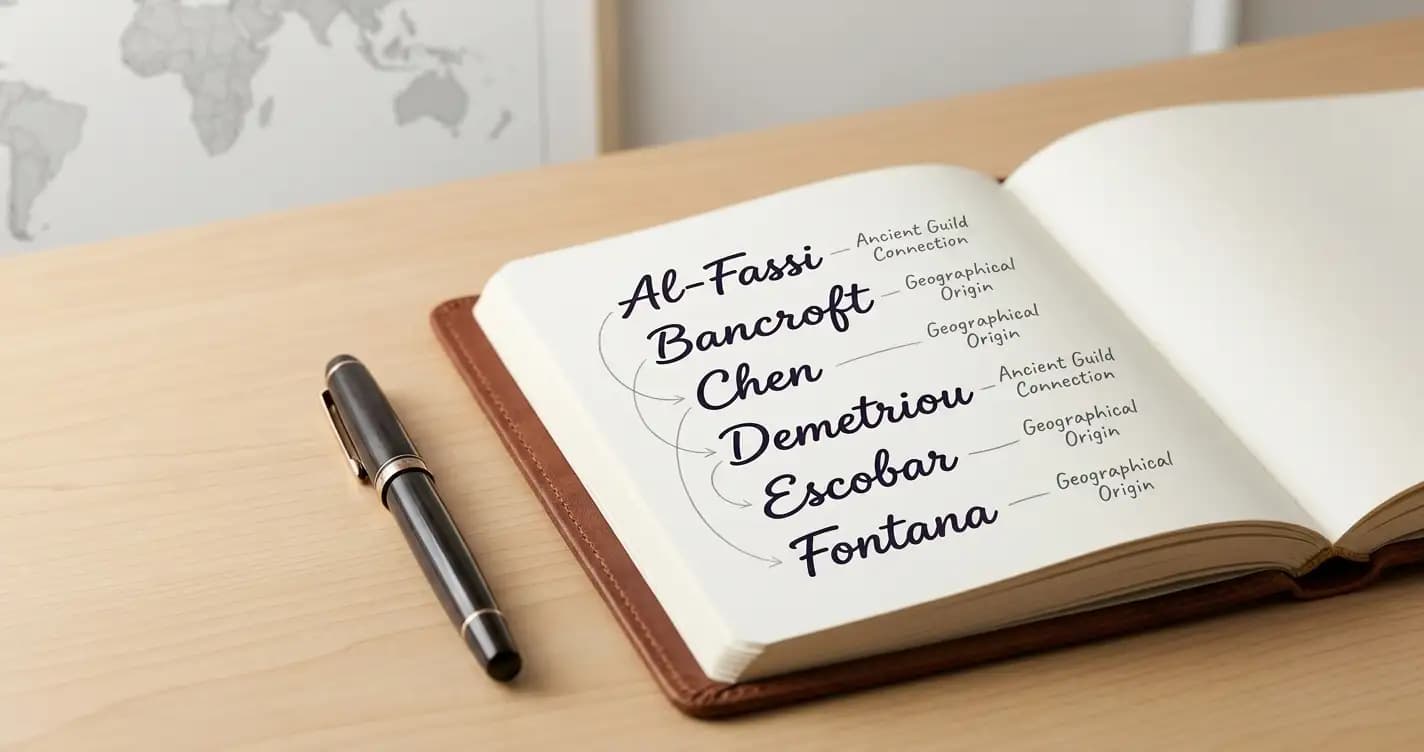
Choose an origin and a texture. Familiar surnames blend into a crowd. Rare surnames stand out and can collide with real families. Place-based names hint at geography. Old trade names (Miller, Baker, Smith in English) feel grounded because they once described work. Formal names can suggest status in a story; they can also feel stiff on a kid.
Each click sends your filters to the AI, then we write the names into PostgreSQL and return that stored batch. Same filters may reuse a recent cache. That is deliberate. It saves the free API and keeps results reviewable.
Surnames are not costumes
If you are writing a character from a culture you do not share, a surname is one of the easiest ways to get it wrong. Prefixes, particles, and order (family name first) vary. Some communities treat certain names as clan markers. Do not scrape a sacred name because it looks cool in Latin letters. Read a style guide. Ask a reader from that community if the story is close to home.
For a fantasy novel, you can invent surnames from sound rules you set. That is safer than borrowing a rare real name. For a contemporary story set in a real city, common surnames are often more truthful than exotic ones.
Surname textures
| Texture | What it signals | Risk |
|---|---|---|
| Familiar | Everyday realism | Hard to search |
| Rare | Distinct identity | Looks like a real family |
| Place-based | Geography | Wrong map |
| Old trade | History and class | Feels medieval in a modern plot |
| Formal | Status | Melodrama |
Double names, hyphens, and particles
Hyphenated surnames solve a family fairness problem and create a forms problem. Airlines, schools, and databases still mishandle hyphens and spaces. If you are naming a fictional couple, decide whether the hyphen is a plot point or just decoration. Particles like de, von, or al are not flavor text. They have grammar. Dropping them at random looks sloppy.
Pairing a surname with a first name
- Say first plus last as a greeting.
- Write the email pattern first.last.
- Check initials.
- Listen for rhymes that turn into jokes.
- Search the full name if the character is modern.
A beautiful surname can still fail next to a sibilant first name. Clusters of s, sh, and ch hiss. Too many unstressed syllables make the name forgettable. Contrast helps: a short given name with a longer surname, or the reverse.
When a last name generator is the wrong tool
Use genealogy software if you are tracing relatives. Use a lawyer if you are changing a legal name. Use the fantasy name generator if you want invented languages more than Earth surnames. Use the baby name page if the real decision is the given name and the surname is already set.
We keep this editorial unique because last names are not just first names with a different label. They behave differently in search, in pride, and in law. Treat them with that weight.
Immigration, spelling, and clerks
Surnames get squeezed through airports and school software. A space, an apostrophe, or a character from another alphabet can vanish on a form. If you are writing a realist story, that friction can be a plot. If you are choosing a name for daily life, test the name in a plain English keyboard. Ask what happens when a form allows only A to Z.
Some families keep two spellings: one for home language, one for official paper. That is a real practice. It is also a lifetime of matching documents. Do not romanticize it in fiction unless you show the cost. Do not choose it in real life unless you are ready for the cost.
Search, privacy, and rare names
A rare surname plus a rare given name is a beacon. Journalists, classmates, and scammers can find a person with one query. A common surname hides in a crowd. Neither is morally better. It is a privacy setting you should pick on purpose. In a novel, a rare name helps the reader track a character. In a small town, it may be too much information.
If you are world-building a court, reuse stems so the phone book of your city feels local. If you are naming one detective in a modern book, search the full name. You do not want to drop a living teacher into a crime plot by accident.
Questions people ask
Can I take a generated surname as my legal last name?
A name change is a legal process. This tool cannot check whether a surname is already tied to a living family, a clan, or a protected title. Talk to the right office where you live.
Will this tell me my ancestry?
No. Similar-sounding surnames appear in many places. Genealogy needs records, not a generator.
Why avoid copying a rare living surname?
Rare surnames can point to real people. In fiction, that can feel like targeting. In real life, it can confuse records. Prefer constructed or widely shared names unless you have a reason.