
Blog
How to name a fantasy character readers can say
A fantasy name should feel like it belongs in the world, and still be easy to say out loud. If readers stumble every time the character walks in, the name is doing too much.
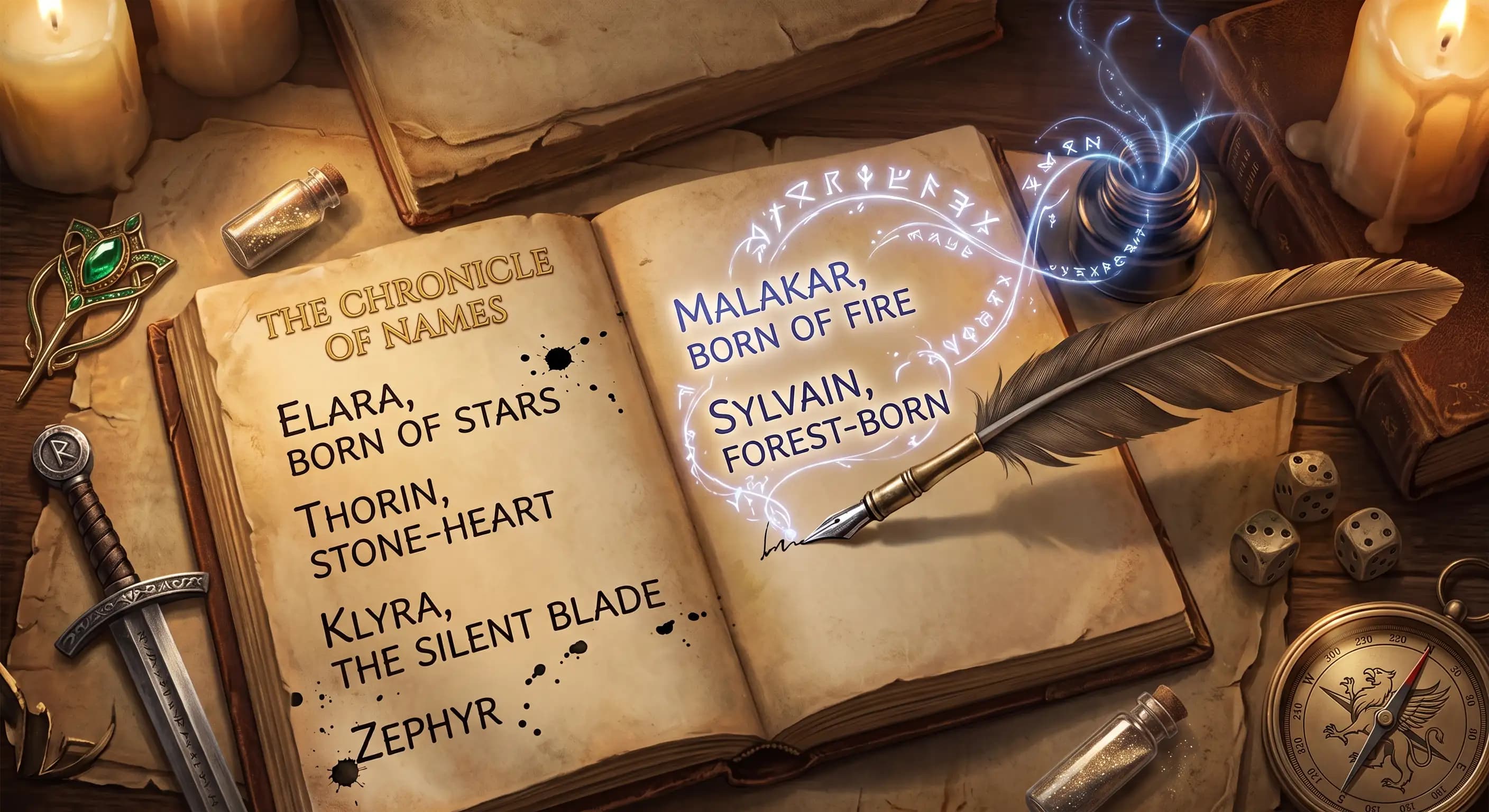
Pick a sound for that culture, then build a name people can pronounce on the first try. Keep the main characters simpler than the lore. Changing one letter in a famous hero is not invention. If you need a footnote to say the name, it is too heavy for someone who appears on every page.
Names are world-building, not stickers
Readers use names to map who belongs with whom. If a woodland scout and a desert priest share the same letter pattern, the map blurs. You do not need a full invented language. You need a few rules you can remember when you are tired. Those rules are the culture.
Start with people, not letters. What do they value? What climate shapes their mouths? Coastal languages often keep rounded vowels. Mountain languages often keep hard stops. This is a sketch, not linguistics homework. The point is consistency, not a journal paper.
Write the rules on a card: allowed consonants, allowed vowels, a suffix that marks family, a particle that marks place. When a generated name breaks the card, throw the name out. The generator is a sketchbook. You are the linguist.
Readability is respect for the reader
A novel is not a font demo. Apostrophes, accents, and unique letters cost attention. One mark can signal otherness. Four marks signal that you wanted the name to look difficult. Difficulty is not depth. Depth is a culture that behaves the same in chapter one and chapter twenty.
Say every name at the table or into a phone. If your friend nicknames the character on the first try, the nickname will win. Sometimes that is fine. If you hate the nickname, the legal name on the page is too hard. Change it while the draft is cheap.
Audio narrators and game masters will bless you for clean stress patterns. Mark the stress in your private notes. You do not have to print a pronunciation guide if the name is obvious. You should print one if the name is a plot password.
Cast roles and name weight
| Role | Name weight | Why |
|---|---|---|
| Viewpoint lead | Light | Repeated hundreds of times |
| Mentor | Medium | Can carry extra syllables |
| Rival | Sharp | Needs a bite, not a paragraph |
| Crowd | Shared pattern | Signals they belong together |
| Ancient relic | Heavy | Rare on the page |
Do not steal, and do not costume
Changing two letters in a famous name is still that famous name. Readers will notice. So will rights holders if you get close to a trademark in a commercial game. Invent a cousin in sound, not a clone in spelling. Search your title plus the name before you lock a cover.
Borrowing a living culture as orc flavor is a different failure. Sacred titles, slurs, and closed names are not props. If your world is inspired by a real place, read people from that place. Hire a sensitivity reader when the story is close. If you cannot do that work, invent.
Surnames, bynames, and titles
Not every culture uses family names. A byname (of the ford, the red) can carry more story than a second invented stem. Titles should mean something in the world. If everyone is a lord, no one is. Give titles a cost.
If you need Earth-like surnames for a low-magic city, use the last name generator and then filter through your class system. If you are blending two houses, the name mixer can suggest a hyphen the public would actually say.
A practical naming session
- Write the culture in one sentence.
- List five allowed sounds.
- Name the lead last, after the world has a texture.
- Generate a batch and keep four.
- Put those four into a sample paragraph and read it aloud.
Name the lead last because you will otherwise twist the world to fit a pretty word. Worlds first. Heroes second. That order also stops you from cloning last year’s favorite show.
When names stall the sentence
If you skip the name while drafting, that is data. The sentence wants a simpler word. You can keep a private long name and a public short name. Many real cultures do that. Your viewpoint character can think of someone as “the smith” until the true name matters.
Lists of twenty named extras are where readers quit. Recycle stems. Give the baker a name that shares a suffix with the miller. The brain loves families of sound. That is how a street feels local.
Tools and limits
Use the fantasy generator when you need volume for a court scene. Use mix names for marriage alliances. Use first names if your story is contemporary fantasy with Earth names. Then come back to the card. The card is the craft.
This guide will not finish your glossary. It will keep you from publishing a name you cannot say. That is the failure that hurts in reviews. Pretty on a wiki and ugly in a mouth is a bad trade.
A note on humor names
Comic names work when the world is comic. They sour when a death scene arrives. If your book turns dark, check the roster. A pun name on a corpse feels like a prank the author played on the reader. Save the jokes for taverns that stay taverns.
If you write for children, remember they will hear the name at bedtime. Cruel phonemes and bathroom jokes travel farther than you think. Be bold. Be kind. Those are not opposites in a name.
Maps, glossaries, and when to stop naming
A glossary is a kindness when names carry meaning in the plot. It is a tax when you invent a word for every shrub. Name what the camera stays on. Let the rest be “the river” until the river matters. Readers forgive a simple landmark. They do not forgive a paragraph of unreadable nouns.
If you publish serial fiction, lock the spelling in a sheet. Future-you will invent a new apostrophe at 1 a.m. Consistency is world-building. A changing name looks like a different person. Copy editors will not save you if the draft never sat still.
Translation and other scripts
If your book may be translated, avoid names that are rude in major languages you can cheaply check. You will not catch everything. You can catch the obvious. Avoid letter combinations that your typesetter will hate. If you use a non-Latin script in-world, decide whether the reader sees a transcription or a glyph. Transcriptions need rules. Glyphs need art. Both need restraint.
Audio rights will expose every clumsy cluster. Read the chapter as if you were paid to narrate it. If you gasp for air on a name, cut letters. The culture can still be rich. The mouth still has to work.
Workshop questions
Ask a reader to pronounce the lead without coaching. If three readers disagree, the name is not ready. Ask whether two characters could be swapped in a scene based on names alone. If yes, change one silhouette. Ask whether any name is doing a joke the scene does not earn. Cut the joke or cut the name.
Series, sequels, and name debt
Each book adds people. Name debt is when you cannot introduce a new face without a footnote. Pay the debt by killing unused names in the outline, not on the page. Recycle stems for servants and soldiers. Save new silhouettes for people who change the plot. If a sequel needs a new culture, write a new sound card before you generate. Do not reuse the woodland card in the desert and hope readers will not notice.
Keep a forbidden list: names you already used, names that are too close, and names that belong to famous books in your genre. Feed that list to your future self. Generators will not remember your last trilogy. You must.
A closing standard
If a friend can shout it, if it follows your card, and if it is not a clone, you have a fantasy name. Everything else is jewelry. Jewelry can wait until the sentence already runs.
NPCs, armies, and the phone book problem
Armies need ranks more than they need unique poetry. Give a unit a pattern: a shared suffix, a number, a color. Name the captain. Let the rest be “the third spear.” When a soldier becomes a person, promote them to a full name that still fits the pattern. Readers feel the culture without memorizing a directory. Directories belong in your notes, not in the chapter where someone is running.